DACH · DE
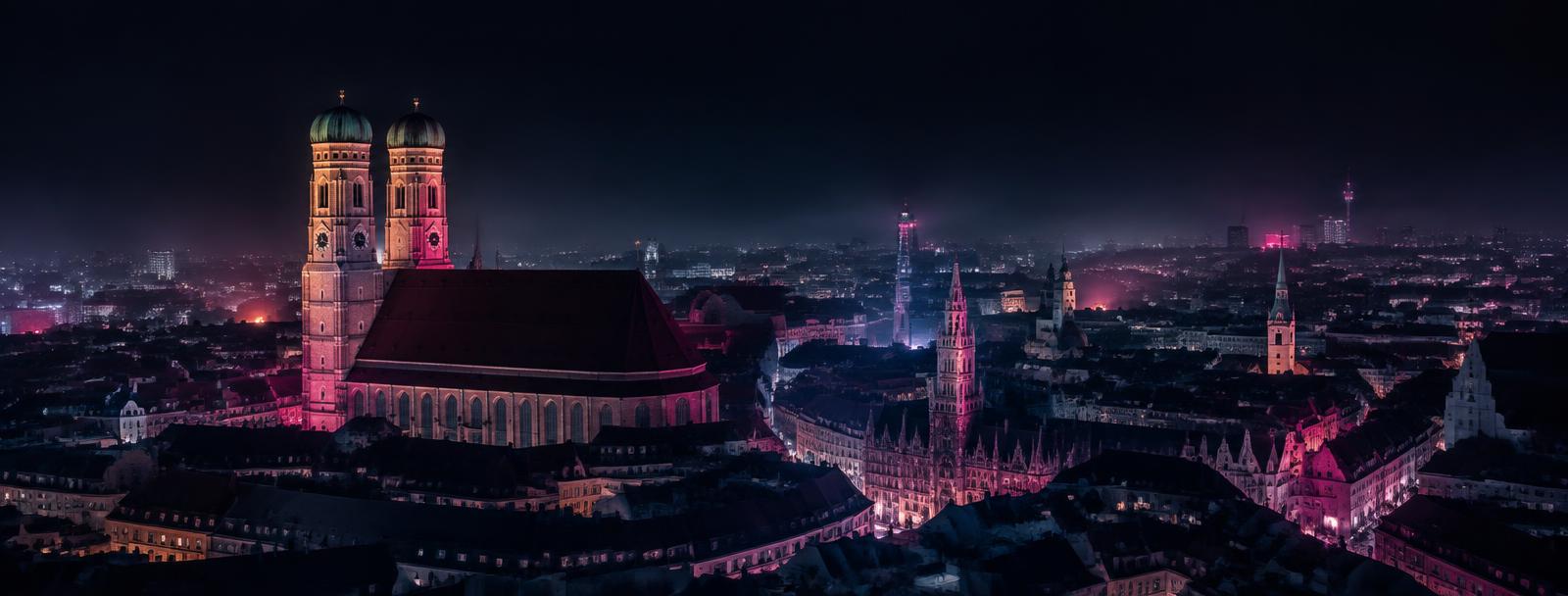
Munich
Selected companies
Machines and the money behind them
The strongest specialisation in the edition - more than twice the European rate on deeptech, nearly twice on climate. It is also the most American-educated city in Europe at 21%, and the least MBA-shaped: 3.3% against London's 16%. And it is the only major hub where most companies start with more than one person.
alqem
Materials Science AIDiscovering materials that unlock technological progress
alqem combines AI with materials science to accelerate discovery, pairing a proprietary database of predicted crystalline materials with in-house synthesis to validate what the models predict. First target is rare-earth-free permanent magnets, a materials class with no major breakthrough in over 40 years. Hanh Nguyen, a former McKinsey Associate Partner with 15 years in chemicals and energy, co-founded the company with Tiago Cerqueira, who helped build the Alexandria materials database, and Milan Allan, who holds an LMU physics chair.
Founded 2026

Arqus
Directed-Energy Defence SystemsProtecting the ultimate high ground
Arqus builds autonomous directed-energy defence systems, patented lasers and electronic-warfare modules that neutralise unmanned threats without physical destruction, protecting critical infrastructure, mobile platforms and space assets. Marnix Meersman, a former ESA engineer, founded the company with Stijn Lafontaine, a robotics engineer who previously built autonomy systems for uncrewed vessels at Fugro, and Anton Liegert.
Founded 2026

Bayshore AI
Legal & Compliance AutomationThe AI Foundation for Legal and Compliance
Bayshore AI builds a legal and compliance “frontdoor” that turns regulation into machine-executable logic, running requests from intake through to decision with a full audit trail. Paul F. Welter, an admitted German lawyer who led Compound AI work at Stanford CodeX, founded the company with Philipp Wiegand and Erik Krauter, whose research background is in manipulation-policy reinforcement learning at ETH.
Founded 2025

Element
Legacy System ModernizationModernize your mainframe, on your terms.
Element modernises mainframe systems for enterprise clients, replacing big bang COBOL rewrites with an incremental, auditable process. Its Global Context Engine maps a codebase's system infrastructure, data flows and business logic before any code changes, so modernisation happens module by module rather than all at once. Alexander Wiener, Lukas Marienfeld and Julian Zeller founded the company with backgrounds spanning TU Munich, a prior startup exit and BCG's banking practice. The team operates out of Munich.
Founded 2025

Grubel
Test-Time Inference & ComputeEvery matter, its own AI
Grubel automates the specialization loop that usually takes AI teams weeks of manual work, so a specialised AI can be built per legal matter through test-time data curation, adaptation and continual evaluation. Moritz Hardt, Director at the Max Planck Institute for Intelligent Systems, founded the lab with Reinhard Heckel, a TUM professor who publishes on inference-time scaling.
Founded 2026

Marble Cognition
AI Coworkers for Business OperationsGive your team their best week, every week
Trymarble, built by Marble Cognition, studies a team's actual repeatable work and builds AI coworkers, with native computer and browser use, that the team can delegate specific tasks to. Felix Rösner, previously at 11x, founded the company with Christophe Schmit, previously at Enam; the two met through Munich's CDTM program.
Founded not yet measured

microagi
Robotics Deployment & DataWe deploy embodied intelligence into the operations that run the physical world, then turn what it learns there into research that compounds.
microagi deploys robots into live factory operations, using its Atlas platform to record how experienced workers do a task, multiply that footage in simulation, and fine-tune a model until the robot can do the job reliably on its own. A separate consumer arm, shift, records everyday chores such as home cleaning in exchange for the service itself, turning ordinary tasks into the same kind of training data. The company was founded by Bercan Kilic, previously an aerodynamics engineer at Red Bull Racing, together with a founding team around him.
Founded 2025

Mkind
High-Mix Manufacturing RoboticsIndustrial robots that work like your expert colleagues
Mkind builds intelligent robots for high-mix manufacturing that scan a new, unknown part and generate an expert trajectory on their own, improving from human corrections over time. Michael Sauer, previously co-founder of Munich tech studio Motius, founded the company with Christoph Willibald and Gabriele Tiboni, whose TUM and DLR robotics research the platform is built on, and Paul Kröger, an ETH and Columbia-trained engineer.
Founded 2026

Poke & Wiggle
Robot Foundation Model DataWe are obsessed with breaking and improving robot policies
Poke & Wiggle runs the largest independent Franka FR3 Duo robot-arm farm, used to stress-test frontier world models and robot policies until they break, then closes the loop with the data and benchmarks that fix them. José Ramón Medina Hernández and Nicolas Keller founded the company. Robot operations are based at Munich's Deutsches Museum.
Founded 2025

Pretty
AI Documents for Finance & ConsultingThe future of office work.
Pretty works with the most ambitious firms in finance and consulting to build client documents in a fraction of the time with AI. Any document, anywhere you are. Felix Wu, Valentin Paul Ostarek and Emil Scheffer founded the company together.
As early-stage VCs, most companies we look at are early, some pre-inception. To properly capture the formation layer, we looked back no more than 18 months from a company's founding, and no more than one institutional round raised.
We believe getting to the core truth of a company radiates from the founding team, and that those signs show up long before a company has its breakout success. So we got on the ground, city by city, talking directly to the ecosystem leaders, university professors, angels, operators and micro VCs who see these companies before anyone else does. The names that kept coming up independently, before they showed up anywhere public, were what we went after.
Every one of those names, alongside thousands of other companies we track a year, went through the same internal scoring model: the scale of impact the company could have globally, how genuinely AI-native the product is, the strength of the thesis, and the team, their talent density, where they've built before, how deep that experience really runs. We ended up with ten companies per city that we believe combine all of the above, while capturing the city's own heartbeat and the themes defining it.
Formations counted
215
Every city in the sample on a log scale, 10 to 1,876 formations. Munich is marked in pink. London sits at the far right as a volume outlier (1,876).
- Rank by formation volume
- 6 of 89
- SHARE OF SAMPLE EUROPEAN FORMATION
- 4.0%
- # FORMATIONS VERSUS THE AVERAGE CITY
- 3.49x
Category mix
What Munich is made of
The categories these 218 companies fall into. AI-first software is the largest.
- AI-first software28%
- Conventional SaaS20%
- Deeptech8%
- Industry software8%
- Consumer8%
Specialisation
What Munich builds
On raw volume most European cities look alike. Character only appears once each theme is compared with a typical European city. Every company now carries a category and sub-theme. Pink marks the categories where Munich differs most; provisional comparisons rest on fewer than 10 companies and are never the lead claim.
Above the line means this city forms more of something than a typical European city does. Below means less.
- Centre line: a typical European city (1.0)
- Forms more than average
- Forms less than average
- Provisional: fewer than 10 companies
- Values read as 1.93x the average, then the theme's share of the city's companies
Typical European city (1.0)
Deeptech2.14x the average · 8.3% of the city+ 2 sub-themes
- Robotics & automation44.4%
- Advanced materials27.8%
Climate1.84x the average · 5.5% of the city+ 2 sub-themes
- Energy generation & transition33.3%
- Carbon & environmental MRV33.3%
AI-first software1.29x the average · 28.4% of the city+ 3 sub-themes
- AI tools for everyday work38.7%
- Robotics & automation8.1%
- Clinics, practices & patient care8.1%
City 4 of 7
Next city: Zurich